How I Found Balance: My Deep Dive into TCM-Inspired Movement
For years, I chased fitness with intense workouts, only to feel drained and out of sync. Then I discovered the quiet power of traditional Chinese medicine (TCM) movement practices—gentle, intentional, and deeply healing. This isn’t about burning calories; it’s about restoring balance. Through tai chi, qi-guiding exercises, and mindful walking, I learned how movement can nourish the body from within. This is my journey into a more sustainable, energy-filled way of being. What began as a search for relief from chronic fatigue turned into a profound shift in how I understand health. It wasn’t more effort I needed—but a different kind of movement, one that supports rather than depletes.
The Burnout Trap: When Exercise Does More Harm Than Good
Many people believe that the harder they push in the gym, the healthier they become. Sweat is seen as proof of progress, and exhaustion mistaken for accomplishment. Yet, for years, this was my routine: early morning HIIT sessions, weight training five days a week, and weekend runs—all in pursuit of strength and stamina. Instead of feeling energized, I often woke up tired, struggled with afternoon crashes, and noticed my immune system weakening. I wasn’t building resilience; I was eroding it.
From the perspective of traditional Chinese medicine, excessive physical strain depletes both Qi and Yin. Qi is the vital energy that powers all bodily functions, while Yin represents the cooling, nourishing, and restorative aspects of our physiology. Constant high-intensity exercise generates internal heat and consumes resources faster than the body can replenish them. Over time, this leads to what TCM calls “empty heat”—a state of fatigue masked by restlessness, poor sleep, and irritability. I began to recognize these signs in myself: my mind felt scattered, my shoulders were always tight, and I craved sugar to keep going.
The turning point came when a trusted wellness practitioner asked a simple question: “Are you moving to build energy—or to burn it?” That question shifted my entire approach. I realized that my workouts, while well-intentioned, were out of harmony with my body’s actual needs. Instead of promoting vitality, they were contributing to depletion. I didn’t need to do more—I needed to do less, but with greater awareness. This insight led me to explore movement systems rooted in balance, not force. What I discovered was not a new trend, but an ancient framework for sustainable well-being: the movement practices of traditional Chinese medicine.
TCM Basics: Understanding Qi, Yin-Yang, and the Organ Systems
To truly appreciate TCM-inspired movement, it helps to understand its foundational principles. At the heart of this system is Qi—the subtle energy that flows through the body, supporting every physiological process. Think of Qi as the breath of life, animating cells, organs, and systems. When Qi flows smoothly, we feel alert, resilient, and at ease. When it becomes blocked or depleted, we experience fatigue, tension, or emotional imbalance.
Another key concept is the dynamic balance between Yin and Yang. Yin represents stillness, nourishment, and internal restoration—qualities associated with rest, fluids, and recovery. Yang embodies activity, warmth, and outward expression—seen in movement, metabolism, and mental focus. Optimal health isn’t about maximizing either one, but maintaining a flexible equilibrium between them. Too much Yang activity without sufficient Yin recovery leads to burnout. Conversely, excessive inactivity can cause stagnation and low energy.
TCM also views the body as a network of functional organ systems, each with a unique role in maintaining harmony. The Liver, for example, ensures the smooth flow of Qi and emotions—when imbalanced, it can contribute to frustration and muscle tension. The Spleen governs digestion and the transformation of food into usable energy; its weakness often shows up as brain fog and fatigue after meals. The Kidneys store the body’s foundational Qi and are closely linked to long-term vitality and stress resilience. When these systems are out of sync, even simple movements can feel laborious.
Unlike Western medicine, which often isolates parts for treatment, TCM sees the body as an interconnected whole. A stiff neck isn’t just a muscular issue—it might reflect Liver Qi stagnation. Low afternoon energy could point to Spleen Qi deficiency. This holistic lens transforms how we approach movement: not as a way to target isolated muscles, but as a method to support the entire energetic system. By understanding these principles, I began to see my body not as a machine to be pushed, but as a living ecosystem to be nurtured.
Why Movement in TCM Isn’t About “Working Out”
In modern fitness culture, movement is often measured by output: calories burned, miles run, pounds lifted. Success is defined by visible results—tighter abs, faster times, increased strength. While these goals have their place, TCM offers a different paradigm: movement as a form of internal regulation. The aim isn’t to exhaust the body, but to awaken its innate intelligence. This shift—from performance to presence—was one of the most transformative aspects of my journey.
TCM-based movement focuses on quality over quantity. It’s not about how fast you move, but how connected you feel. Each motion is performed with attention to breath, alignment, and intention. The goal is to stimulate the flow of Qi, release blockages, and support organ function. For example, a slow arm raise in qi-gong isn’t just stretching the shoulder—it’s guiding energy along specific meridians, calming the mind, and activating the Lungs’ role in Qi distribution.
This approach resonated deeply with me because it honored my body’s signals instead of overriding them. There were days when I used to force myself to run despite feeling drained. Now, I might choose a five-minute breathing exercise or a gentle swaying sequence instead. These practices don’t look impressive on social media, but they leave me feeling centered and replenished. I’ve learned that true strength isn’t measured by how much I can endure, but by how well I can listen.
Another key difference is the role of stillness. In TCM, stillness isn’t passive—it’s an active state of receptivity. Many practices include moments of pause, allowing the body to integrate movement and the mind to settle. This contrasts sharply with the non-stop pace of most workout routines. By embracing stillness, I’ve cultivated a deeper awareness of my internal state. I notice subtle shifts—tightness in the chest, a racing pulse, a sense of heaviness—and respond with appropriate movement or rest. This mindful responsiveness is at the core of TCM’s preventive philosophy: maintaining balance before imbalance becomes illness.
Tai Chi: The Art of Moving Meditation
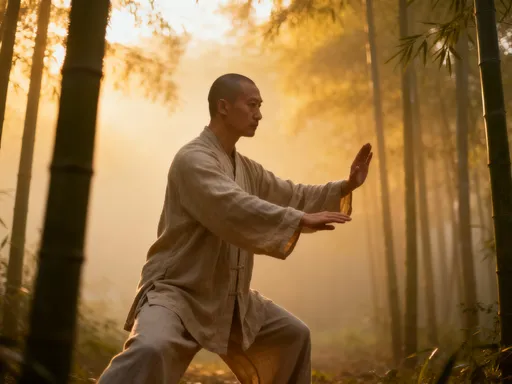
Among the most well-known TCM movement practices, tai chi stands out for its elegance and depth. Often described as “meditation in motion,” it combines slow, flowing movements with coordinated breathing and focused intention. I first tried tai chi during a period of high stress and poor sleep. Skeptical but curious, I joined a beginner class at a local community center. Within weeks, I noticed changes: my sleep improved, my shoulders relaxed, and I felt more grounded throughout the day.
Tai chi works on multiple levels. Physically, it enhances balance, coordination, and joint mobility—important for long-term health, especially as we age. But its deeper benefits lie in its effect on the nervous system. The rhythmic, deliberate movements activate the parasympathetic response, helping to reduce cortisol levels and calm the mind. From a TCM perspective, this supports the Heart and calms the Shen, or spirit, which is easily disturbed by modern life’s constant stimulation.
One of the core principles of tai chi is “song,” often translated as “relaxation with awareness.” It’s not about going limp, but about releasing unnecessary tension while maintaining structural integrity. This concept was challenging at first—my instinct was to “do it right” and hold myself rigidly. But with practice, I learned to move with softness and fluidity, allowing energy to circulate more freely. I started with just ten minutes a day, following a simple 12-move form. Over time, I built up to 30-minute sessions, often in the morning to set a calm tone for the day.
Another important aspect is breath coordination. In tai chi, inhalation typically accompanies expansive movements—like opening the arms—while exhalation supports contraction or grounding. This natural rhythm helps synchronize the body and mind. I found that focusing on my breath during practice made it easier to stay present and less reactive during stressful moments off the mat. Tai chi didn’t replace my other activities, but it transformed how I approached them—with greater patience, awareness, and ease.
Qi-Gong: Simple Exercises That Make a Real Difference
If tai chi is a dance of energy, qi-gong is its focused counterpart—a set of targeted exercises designed to cultivate, circulate, and balance Qi. I began exploring qi-gong after reading about its benefits for fatigue and emotional regulation. What surprised me was how simple the movements were—and how powerful their effects. Unlike complex fitness routines, qi-gong emphasizes repetition, breath, and mental focus over physical intensity.
One of the first practices I tried was “Lifting the Sky.” Standing with feet shoulder-width apart, I slowly raised my hands in front of me, palms up, imagining I was lifting a ball of energy above my head. Then, with a gentle exhale, I lowered my hands as if pushing water down my torso. This sequence, repeated for five to ten minutes, created a noticeable sense of uplift and clarity. From a TCM perspective, it stimulates the Governing and Conception meridians, helping to regulate the entire energy system.
Another favorite is “Separating Heaven and Earth.” One hand rises above the head, palm facing up, while the other sinks toward the ground, palm down. As I shifted my weight side to side, I visualized drawing energy from the earth and sky, harmonizing Yin and Yang. This practice was especially helpful on days when I felt scattered or overwhelmed. It grounded me while also lifting my mood.
Over an eight-week period, I committed to practicing qi-gong for 15 minutes each morning. I tracked subtle changes: improved focus at work, less afternoon fatigue, and a greater sense of emotional stability. These weren’t dramatic transformations, but steady, cumulative improvements. Research supports these observations—studies have shown that regular qi-gong practice can reduce stress, improve sleep quality, and enhance immune function. The beauty of qi-gong lies in its accessibility: it requires no special equipment, can be done indoors or outdoors, and adapts easily to different energy levels. On low-energy days, I might do just a few repetitions; on stronger days, I extend the session. This flexibility makes it sustainable for long-term practice.
Daily Integration: Turning Walking and Stretching into Therapy
One of the most empowering realizations was that I didn’t need a formal practice to benefit from TCM principles. Even everyday activities like walking or stretching could become therapeutic when done with awareness. I started paying attention to how I moved throughout the day—how I stood while washing dishes, how I sat at my desk, how I walked from the car to the store.
Mindful walking, in particular, became a cornerstone of my routine. Instead of rushing with my mind on the next task, I began to walk with intention: feeling my feet connect with the ground, syncing my breath with my steps, noticing the rhythm of my body. This simple shift transformed a mundane activity into a moving meditation. From a TCM viewpoint, walking stimulates the Spleen and Stomach meridians, aiding digestion and energy production. When done mindfully, it also calms the mind and grounds the spirit.
I also reimagined stretching. Rather than forcing my body into deep poses, I adopted a gentler approach—slow, sustained movements that invited release rather than resistance. I focused on areas where I held tension: the neck, shoulders, and lower back. I learned that in TCM, the Liver governs the tendons, and emotional stress often manifests as physical tightness. By moving gently and breathing deeply, I could soften these areas and support Liver Qi flow.
Even short breaks during the day became opportunities for restoration. At work, I’d stand up every hour and do a few “micro-practices”—rotating my wrists, rolling my shoulders, or doing a standing spinal wave. These moments of mindful movement helped prevent stiffness and mental fatigue. I also began taking evening walks with my partner, turning them into shared moments of connection and calm. By integrating TCM-inspired movement into daily life, I made wellness a constant, not a chore.
Putting It All Together: A Balanced Weekly Movement Plan
After months of experimentation, I developed a weekly rhythm that honors both activity and rest. This plan isn’t rigid—it adapts to my energy levels, the season, and life’s demands. But it follows a consistent principle: balance. I aim to include a mix of tai chi, qi-gong, mindful walking, and rest, aligning with TCM’s emphasis on harmony with natural cycles.
My typical week includes tai chi three times—usually on Monday, Wednesday, and Friday mornings. These sessions last 20 to 30 minutes and help me start the day with clarity. On Tuesdays and Thursdays, I practice qi-gong, focusing on specific routines that support digestion or calm the nervous system. Saturdays are for longer, mindful walks—often in nature, which TCM considers deeply nourishing for the Qi. Sundays are gentle: light stretching, breathing exercises, or complete rest.
This structure reflects TCM’s understanding of circadian and seasonal rhythms. In the morning, when Yang energy rises, I engage in slightly more active practices. In the evening, as Yin energy increases, I shift toward calming activities. During colder months, I emphasize grounding and internal focus; in warmer seasons, I allow for more expansive movement. I also pay attention to how I feel each day. If I wake up exhausted, I might skip a planned session and opt for a short breathing practice instead. This responsiveness is key—it keeps the routine sustainable and personalized.
What I’ve learned is that consistency matters more than intensity. Even five minutes of intentional movement can make a difference. Over time, these small moments accumulate into lasting change: more stable energy, better sleep, and a greater sense of well-being. This plan isn’t about perfection—it’s about presence, patience, and partnership with my body.
My journey into TCM-inspired movement wasn’t about finding a quick fix—it was about rediscovering harmony. By aligning with natural rhythms and honoring my body’s signals, I’ve gained more energy, better mood, and a deeper connection to my health. This approach isn’t about replacing modern fitness, but enriching it with ancient wisdom. The real power lies not in how hard we push, but in how well we flow. Through tai chi, qi-gong, and mindful daily movement, I’ve learned to move in a way that nourishes rather than depletes. It’s a practice of listening, of softening, of returning to balance—one breath, one step, one moment at a time. And in that quiet, intentional motion, I’ve found a deeper kind of strength.